
On this page
- What is a seamless gutter?
- How do seamless and sectional gutters compare?
- Which parts make up a seamless system?
- How is a seamless gutter installed?
- Which size and metal should a seamless gutter be?
- What do seamless gutters cost?
- Why do seamless gutters still leak sometimes?
- Seamless gutters: quick answers
- Where does seamless gutters come up around Acadiana?
- What is the one thing to do first?
What is a seamless gutter?
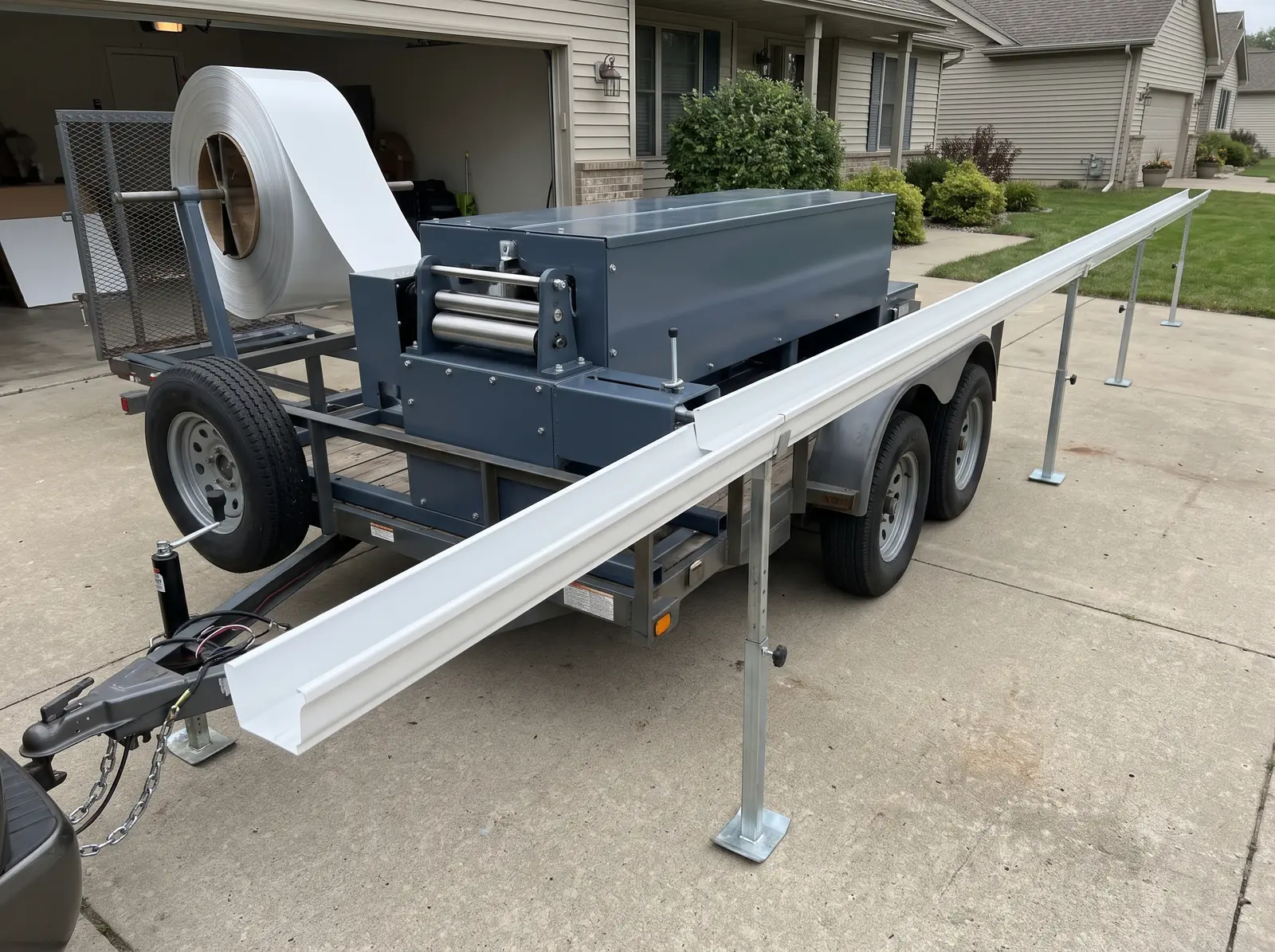
A seamless gutter is formed at the house. The contractor feeds flat, factory-painted coil through a roll-forming machine, usually mounted on a trailer, and the machine shapes it into a K-style or half-round profile of whatever length the wall needs. A 40-foot eave gets a 40-foot gutter, with no joints in between.
Sectional gutters, by contrast, come in fixed lengths joined with slip connectors and sealant. Every connector is a seam, and seams are where gutters leak. In a climate with close to 63 inches of rain a year and long, hot summers that dry out sealant, removing those seams matters.
How do seamless and sectional gutters compare?
| Sectional | Seamless | |
|---|---|---|
| Joints | One every 10 feet or so | Only at corners, ends and outlets |
| Leaks | Sealant at each joint ages and fails | Far fewer places to leak |
| Fit | Stock lengths cut to suit | Formed to each wall |
| Appearance | Visible seams along the eave | One continuous line |
| Materials | Aluminum, vinyl, steel | Aluminum, steel, copper |
| Installed by | Homeowners or contractors | Contractors with a machine |
The seamless vs sectional guide goes further into cost and when sectional still makes sense.
Which parts make up a seamless system?
| Term | What it means on a Lafayette house |
|---|---|
| Coil stock | The roll of factory-painted aluminum, steel or copper fed through the gutter machine. |
| Seamless gutter | Gutter rolled out of a coil of painted metal on a machine at the house, one piece per wall, so joints only occur at corners and ends. |
| K-style gutter | The common flat-backed gutter with a molded front face. It carries more water than a half-round of the same nominal width. |
| Gauge | Metal thickness. Residential aluminum gutter is usually .027 or .032 inch; the heavier coil shrugs off ladders, limbs and flying debris better. |
| Hidden hanger | A bracket that hooks under the front lip and screws through the back of the gutter into the fascia, unseen from the yard. |
| Miter | The joint at a corner, cut, riveted and sealed. Corners carry the most water and are where most leaks start. |
| End cap | The closure crimped and sealed onto each end of a run. |
| Outlet | The opening in the gutter bottom where the downspout drops away, usually lined with a riveted sleeve. |
| Slope | The fall of a gutter toward its outlet, often around a quarter inch per 10 feet, enough to keep water moving without looking crooked. |
| Drip edge | Bent metal flashing along the roof edge that kicks water out past the fascia and into the trough instead of letting it creep back behind the gutter. |
How is a seamless gutter installed?
- Measure. Each eave is measured to the inch and outlets are planned so no stretch carries more water than its downspout can drain.
- Prepare the edge. Soft fascia is replaced and a drip edge or gutter apron added if missing.
- Form. The machine rolls each run from coil, and the contractor carries it to the wall in one piece.
- Cut outlets and fit ends. Outlets are cut and sleeved, and end caps are crimped, riveted and sealed.
- Hang. Hidden hangers go in about every 2 feet, set so the run falls toward its outlets.
- Join corners. Inside and outside miters are cut, riveted and sealed, or premade corners are fitted.
- Connect downspouts. Elbows and pipe are fitted and strapped, and drainage is added at the bottom.
- Test. Water is run through each gutter to check slope and look for drips.
Which size and metal should a seamless gutter be?
| House | Suggested size | Metal |
|---|---|---|
| Single-story ranch, simple roof | 5-inch | .027 aluminum |
| Single-story with valleys or long porch roof | 5 or 6-inch | .027 or .032 aluminum |
| Two-story new build | 6-inch | .032 aluminum |
| Raised cottage or historic house | Seamless half-round, often 6-inch | Aluminum or copper |
| Under heavy trees or exposed to storms | 6-inch | .032 aluminum or Galvalume |
See the 6-inch gutters page and the aluminum gutters page for more detail.
What do seamless gutters cost?
National guides put seamless aluminum at roughly $9 to $13 a foot installed for 5-inch and $12 to $18 for 6-inch, per Angi. Height, corners, downspout count, fascia repair and drainage all move the total. These are national ranges, not local quotes; the cost guide explains what drives a Lafayette quote.
Why do seamless gutters still leak sometimes?
Because corners, end caps and outlets are still joints. If those are not riveted and sealed carefully, or if the gutter is hung too flat so water sits at a joint, a seamless system will drip there. Long runs also expand and contract with heat; on a very long wall, a contractor may add an expansion joint or split the run. And no gutter survives being hung on soft fascia. The leaking gutters page covers repairs.
Seamless gutters: quick answers
| Question people ask | Short answer |
|---|---|
| Is seamless the same as one-piece? | Along each wall, yes; corners and ends are still joined |
| Can a seamless run be extended later? | A short added run is joined with a sealed lap; matching color is easiest when coil is fresh |
| Does seamless work on metal roofs? | Yes, usually 6-inch to catch fast runoff |
| Are seamless gutters harder to repair? | No; a damaged length can be cut out and re-formed |
Where does seamless gutters come up around Acadiana?
| Town or neighborhood | Why it matters there |
|---|---|
| Youngsville | Long walls on new two-story houses suit one-piece runs |
| Scott | Simple ranches get long, clean seamless lines |
| Abbeville | Fewer joints mean fewer weak points in hurricane wind |
What is the one thing to do first?
Ask each contractor how many joints the system will have, where they fall, and how corners will be sealed. That one question separates careful quotes from quick ones.