
On this page
Which gutter problems can be repaired?
Most of what goes wrong with a gutter is local: one corner, one seam, a few hangers, one downspout. Those are repairs. When faults are everywhere at once, the system is usually telling you it has reached the end, and the replacement page covers that decision.
| Problem | Usual cause | Typical repair | Page |
|---|---|---|---|
| Drip at a corner or end | Sealant dried out by heat and movement | Clean, rivet, reseal | Leaking gutters |
| Run bowing or pulling away | Spikes backed out, hangers too far apart, soft fascia | Rehang on hidden hangers, replace wood | Sagging gutters |
| Water over the front in storms | Undersized outlets, clogs, lost slope, valleys | Clear, add outlets, re-pitch, upsize | Heavy-rain overflow |
| Dents, tears, sections down | Hurricane wind, squall lines, limbs, hail | Replace damaged lengths, refasten | Storm and hail damage |
| Downspout loose, crushed or blocked | Packed elbows, mowers, straps pulled out | Clear, replace sections, restrap | Downspout repair |
| Rot, stains, peeling paint | Water running behind the gutter | Replace fascia and soffit, add drip edge | Fascia and soffit |
What symptoms point to which fault?
Water sheets over the front during a summer downpour
The trough or outlet is packed with oak leaves and catkins, or the gutter is too small for the roof above it. Heavy-rain overflow
A drip that never stops at a corner or end cap
Sealant at a miter or end cap has dried out in the heat. Most joints can be cleaned, riveted and resealed. Leaking gutters
A run that bows, tilts or pulls off the house
Spikes have backed out, hangers are spaced too far apart, or the fascia behind has gone soft in the humidity. Sagging gutters
Bent, torn or missing gutter after a hurricane or squall line
Photograph it from the ground, keep clear of loose metal and lines, then book an inspection. Storm and hail damage
A downspout that gurgles, backs up or swings loose
An elbow is jammed with leaves and seed, or the straps have pulled out of the siding. Downspout repair
Water standing along the slab or under a raised house
The downspouts let go too close to the house on flat ground. Extensions, splash blocks or buried lines usually fix it. Downspout drainage
How does Lafayette's climate wear gutters out?
Four things do most of the damage here.
Rain volume. Close to 63 inches a year, per the NOAA normals, means gutters carry water far more often than in most of the country. Every overflow sends water behind the gutter onto the fascia, and every heavy storm tests the outlets.
Heat and humidity. Long hot summers dry out sealant at corners and end caps, and constant humidity keeps fascia damp. Wood that stays wet softens, screws lose their grip, and the run starts to sag.
Trees. Live oaks drop leaves and stringy catkins in spring, water oaks and pines add more, and the debris packs into outlets and elbows. A gutter that holds wet debris is heavy and slow to drain.
Wind. Hurricanes and the squall lines that come ahead of them peel gutters off houses. Hurricane Lili in 2002 brought estimated gusts of 70 to 80 mph to Youngsville and Maurice, and in 2020 Hurricane Delta's eye passed over Lafayette itself. Loose spikes and widely spaced hangers are the first to fail.
Which repair terms come up?
| Term | What it means on a Lafayette house |
|---|---|
| Miter | The joint at a corner, cut, riveted and sealed. Corners carry the most water and are where most leaks start. |
| End cap | The closure crimped and sealed onto each end of a run. |
| Hidden hanger | A bracket that hooks under the front lip and screws through the back of the gutter into the fascia, unseen from the yard. |
| Spike and ferrule | An older fixing: a long nail through a sleeve inside the gutter. Wind, weight and wood movement slowly lever it out of the board. |
| Slope | The fall of a gutter toward its outlet, often around a quarter inch per 10 feet, enough to keep water moving without looking crooked. |
| Outlet | The opening in the gutter bottom where the downspout drops away, usually lined with a riveted sleeve. |
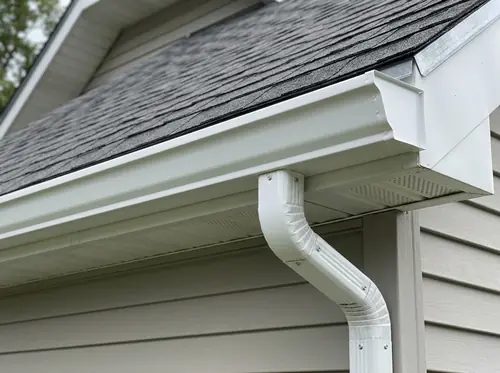
| Downspout | The pipe that carries water from the gutter to the ground. 2x3 and 3x4 inch are standard; a 3x4 carries roughly twice as much. |
| Fascia | The board that caps the ends of the rafters. Every hanger bites into it, and in south Louisiana humidity a wet fascia softens fast. |
| Soffit | The flat underside of the roof overhang, often vented. Dark stains or swelling here point to water slipping behind the gutter. |
| Drip edge | Bent metal flashing along the roof edge that kicks water out past the fascia and into the trough instead of letting it creep back behind the gutter. |
| Gutter apron | A broad flashing slipped under the first row of shingles and lapped into the gutter, used where shingles stop short of the trough. |
| Splash block | A concrete or plastic tray under a downspout that spreads the flow and stops it scouring a hole. |
How is a typical gutter repair done?
- Inspect. The contractor walks the house, then checks each run from a ladder, presses on the fascia and runs water to watch where it goes.
- Clear. Troughs and downspouts are emptied so the real fault can be seen.
- Fix the cause. Joints are resealed, hangers added or replaced, slope corrected, outlets enlarged, and damaged lengths cut out and replaced.
- Fix the wood. Soft fascia is replaced before anything is rehung on it.
- Test. Water runs through each repaired section to confirm it drains to the outlet without dripping.
- Check the ground. Downspouts are followed to where they empty, and an extension added if the water lands too close.
When does repair stop making sense?
| Sign | Repair | Replace |
|---|---|---|
| One or two leaking corners | Yes | |
| Sagging in one spot, sound fascia | Yes | |
| Leaks at many seams on sectional gutter | Usually | |
| Rust through on steel | Yes | |
| Spikes pulling out along every run | Rehang may work | Often better |
| Gutter too small for the roof everywhere | Yes, with 6-inch | |
| Fascia rotted along most of the house | Usually, together with the wood |
The repair or replace guide sets out the trade-offs and costs.
What should you do while you wait for a repair?
- Keep the downspouts and outlets clear if you can do it safely from the ground or a short ladder.
- Put a temporary extension or a splash block under any downspout emptying against the house.
- Move anything valuable away from a wall where water is falling.
- Do not climb onto a wet or steep roof, and stay off ladders in wind or near power lines.