
On this page
- What does a new gutter installation include?
- Which types of gutter installation are there?
- How big should gutters be for Lafayette rain?
- Which parts make up a gutter system?
- How is a seamless gutter installed?
- Which metal is right for a Lafayette house?
- What should you ask before you hire?
- What else should you know before installing?
What does a new gutter installation include?
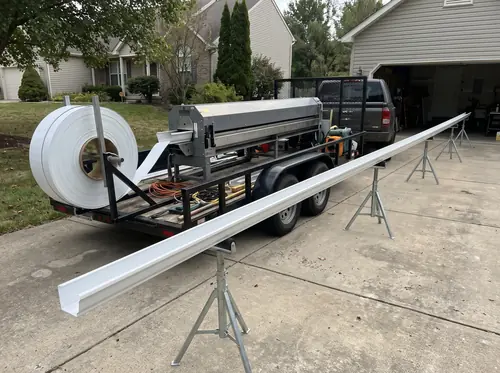
A full installation covers everything from the roof edge to where the water leaves the yard. The old gutters, spikes and downspouts come down and are hauled away. The contractor checks every fascia board and replaces any that are soft, measures each eave, and runs seamless lengths off a coil on a machine parked at the house. Each run is pitched toward its outlets, fixed with hidden hangers, sealed at the corners and end caps, and connected to downspouts that carry the water somewhere it can drain.
That last part is the one most likely to be skimped. Lafayette sits on flat prairie where a few inches of fall across a yard is normal, and a downspout that empties beside the slab simply moves the problem. Good installs finish with extensions, splash blocks or buried lines that take the water to ground sloping away from the house, a ditch, a swale or the street.
Which types of gutter installation are there?
| Type | Where it fits around Lafayette | Page |
|---|---|---|
| Seamless aluminum K-style | Most houses; the everyday choice | Seamless gutters |
| 6-inch K-style | Two-story walls, steep roofs, valleys, heavy tree cover | 6-inch gutters |
| Aluminum in .032 inch | Under limbs, on tall walls, in storm-exposed spots | Aluminum gutters |
| Half-round | Raised cottages, Queen Anne and Colonial Revival houses | Half-round gutters |
| Copper | Historic houses, brick and stone, long-life builds | Copper gutters |
| Downspouts and drainage | Every house; the half of the job most often missed | Downspouts |
How big should gutters be for Lafayette rain?
Start with the rain. The 1991 to 2020 normals for Lafayette Regional Airport, listed on Wikipedia, average 62.81 inches of precipitation a year, with June the wettest month at 7.09 inches and no month below 3.7 inches. Monthly totals understate the real test, though, which is how hard it rains for an hour. In the August 2016 flood Lafayette logged two straight days with more than 10 inches each, and on the morning of 24 April 2025 five to eight inches fell on downtown Lafayette, Broussard and Youngsville in a few hours. A gutter that copes with a normal afternoon storm can be overwhelmed by rain like that.
Sizing follows the roof, not the floor plan. Contractors weigh four things:
- Roof area per run. The square footage that sheds into each gutter, adjusted for pitch, since a steeper roof catches more wind-driven rain.
- Valleys. A valley can pour two roof planes into a few feet of gutter, which is why inside corners overflow first.
- Outlets. More outlets and bigger downspouts often matter more than a wider trough. A 3x4 downspout carries about twice what a 2x3 does.
- Debris. Under live oaks and pines, a bigger gutter and bigger outlets clog less often.
| House | Typical choice |
|---|---|
| Single-story slab ranch, simple hip or gable roof | 5-inch K-style, 2x3 or 3x4 downspouts every 30 to 40 feet |
| Single-story with valleys or a long porch roof | 5 or 6-inch, 3x4 downspouts at each inside corner |
| Two-story new build in Youngsville, Broussard or Scott | 6-inch K-style, 3x4 downspouts |
| Raised cottage or historic house | Half-round, often 6-inch, with round downspouts |
| Steep metal roof | 6-inch with heavier hangers; metal sheds water fast |
The 5-inch vs 6-inch guide works through the choice in more detail.
Which parts make up a gutter system?
| Term | What it means on a Lafayette house |
|---|---|
| Drip edge | Bent metal flashing along the roof edge that kicks water out past the fascia and into the trough instead of letting it creep back behind the gutter. |
| Gutter apron | A broad flashing slipped under the first row of shingles and lapped into the gutter, used where shingles stop short of the trough. |
| Fascia | The board that caps the ends of the rafters. Every hanger bites into it, and in south Louisiana humidity a wet fascia softens fast. |
| Seamless gutter | Gutter rolled out of a coil of painted metal on a machine at the house, one piece per wall, so joints only occur at corners and ends. |
| K-style gutter | The common flat-backed gutter with a molded front face. It carries more water than a half-round of the same nominal width. |
| Hidden hanger | A bracket that hooks under the front lip and screws through the back of the gutter into the fascia, unseen from the yard. |
| Miter | The joint at a corner, cut, riveted and sealed. Corners carry the most water and are where most leaks start. |
| End cap | The closure crimped and sealed onto each end of a run. |
| Outlet | The opening in the gutter bottom where the downspout drops away, usually lined with a riveted sleeve. |
| Downspout | The pipe that carries water from the gutter to the ground. 2x3 and 3x4 inch are standard; a 3x4 carries roughly twice as much. |
| A elbow | A downspout elbow that turns front to back, used to bring the pipe in from the overhang to the wall. |
| B elbow | A downspout elbow that turns side to side, used to dodge a window or run along a wall. |
| Splash block | A concrete or plastic tray under a downspout that spreads the flow and stops it scouring a hole. |
| Buried drain line | Solid pipe laid underground from a downspout to a ditch, curb, swale or a lower part of the yard. |
How is a seamless gutter installed?
- Take down the old system. Spikes, straps and downspouts come off, and the fascia behind gets its first proper look in years.
- Repair the wood. Soft fascia and rafter tails are replaced, and a drip edge or gutter apron is added where the roof edge lacks one.
- Measure and plan. Each eave is measured and outlets are placed so no stretch of gutter carries more water than its downspout can drain.
- Form the runs. The machine rolls each length from painted coil, so long walls are one piece.
- Hang and pitch. Hidden hangers go in about every 2 feet, screwed through into the fascia, with the run sloped toward its outlet.
- Seal corners and ends. Miters and end caps are riveted and sealed, the step that decides whether the system drips in five years.
- Fit downspouts. Outlets are cut, A and B elbows bring the pipe to the wall, and straps fix it every few feet.
- Finish the drainage. Extensions, splash blocks or buried lines take the water well away, and a hose test confirms every run drains.
Which metal is right for a Lafayette house?
| Metal | Strengths | Points to weigh in Lafayette | Typical national installed price |
|---|---|---|---|
| Aluminum .027 inch | Light, rustproof, many colors | Fine on most single-story houses | $9 to $13 a foot for 5-inch |
| Aluminum .032 inch | Stiffer, better against limbs and ladders | Worth it on tall walls and under trees | Slightly above .027 |
| Galvalume steel | Strong, dent-resistant | Cut edges need sealing in humid air | $6 to $14 a foot |
| Copper | Very long life, period look | Higher cost; suits historic houses | $25 to $40 a foot |
Prices are national ranges from Angi and This Old House, not local quotes. The metals guide goes further.
What should you ask before you hire?
- What size gutter and downspouts are you quoting, and why for this roof?
- Is it seamless, and what metal and thickness?
- What hangers, how far apart, and what do they screw into?
- Will you replace soft fascia, and how is that charged?
- Where will each downspout empty, and how far from the house?
- Which Louisiana registration or license applies to this job?
What else should you know before installing?
Timing. Spring, after the live oaks finish dropping catkins, and the drier weeks of fall are the easiest windows. Booking before June means gutters are ready before the heaviest months of rain and the peak of hurricane season.
Roof first if it is due. If the roof is near the end of its life, it is usually better to reroof first. Gutters often have to come down for a reroof, and the drip edge should go in with the new shingles.
Drainage rules. Downspouts should drain onto your own property or into a street or ditch, not straight onto a neighbor's lot. Lafayette Consolidated Government also runs a yearly rain barrel sale for residents who want to store some roof water.