
On this page
- Why choose a 6-inch gutter?
- When does a 6-inch gutter make sense?
- Which terms matter when sizing gutters?
- How do contractors size gutters?
- What does upsizing look like on a typical house?
- What do 6-inch gutters cost?
- Does a bigger gutter fix every overflow?
- 6-inch gutters: quick answers
- Where does 6-inch gutters come up around Acadiana?
- What is the one thing to do first?
Why choose a 6-inch gutter?
Because of how hard it rains. Lafayette averages 62.81 inches a year, but the gutter is tested by intensity, not totals: an inch or two in an hour from a summer storm, or the kind of rain that fell in the August 2016 flood, when the city had two consecutive days above 10 inches. When a 5-inch gutter is full and its 2x3 downspout cannot drain it fast enough, the rest goes over the front onto the fascia, walls and ground beside the slab.
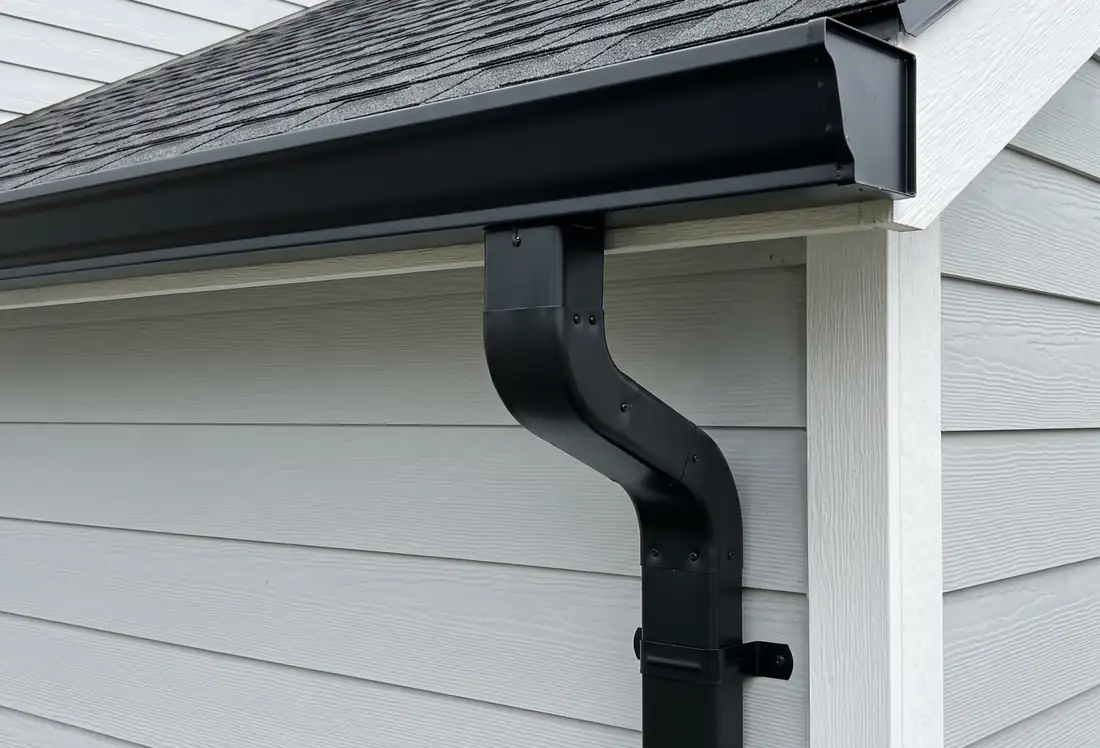
A 6-inch gutter gives more room in the trough and, paired with 3x4 downspouts, drains far faster. It also tolerates a bit of debris without overflowing.
When does a 6-inch gutter make sense?
| Situation | 5-inch | 6-inch |
|---|---|---|
| Small single-story roof, simple shape | Usually fine | Optional |
| Long single-story roof with few outlets | Add outlets | Worth considering |
| Two-story walls | Often marginal | Recommended |
| Steep roof (above about 8/12) | Often overflows | Recommended |
| Valleys dumping into one corner | Overflows at the corner | Recommended at least there |
| Metal roof | Water arrives fast | Recommended |
| Heavy oak or pine cover | Clogs quickly | Helps, with guards |
Which terms matter when sizing gutters?
| Term | What it means on a Lafayette house |
|---|---|
| K-style gutter | The common flat-backed gutter with a molded front face. It carries more water than a half-round of the same nominal width. |
| Downspout | The pipe that carries water from the gutter to the ground. 2x3 and 3x4 inch are standard; a 3x4 carries roughly twice as much. |
| Outlet | The opening in the gutter bottom where the downspout drops away, usually lined with a riveted sleeve. |
| Roof valley | Where two roof planes meet and form a channel. It funnels both slopes into one short stretch of gutter. |
| Slope | The fall of a gutter toward its outlet, often around a quarter inch per 10 feet, enough to keep water moving without looking crooked. |
| Hidden hanger | A bracket that hooks under the front lip and screws through the back of the gutter into the fascia, unseen from the yard. |
| Gauge | Metal thickness. Residential aluminum gutter is usually .027 or .032 inch; the heavier coil shrugs off ladders, limbs and flying debris better. |
| A elbow | A downspout elbow that turns front to back, used to bring the pipe in from the overhang to the wall. |
| B elbow | A downspout elbow that turns side to side, used to dodge a window or run along a wall. |
How do contractors size gutters?
- Measure roof area per run. The area of each roof plane that drains into a gutter, including any upper roof that sheds onto a lower one.
- Adjust for pitch. Steeper roofs catch more wind-driven rain and send water faster.
- Find concentration points. Valleys and places where an upper roof dumps onto a lower roof need extra capacity.
- Set outlets. Enough downspouts, often at each inside corner and every 30 to 40 feet on long runs.
- Choose size. 5-inch or 6-inch for each run, with 2x3 or 3x4 downspouts to match.
What does upsizing look like on a typical house?
| House | Before | After |
|---|---|---|
| Two-story in Youngsville | 5-inch, 2x3 downspouts, overflow at inside corners | 6-inch, 3x4 downspouts, extra outlet at each valley |
| Single-story ranch in Carencro | 5-inch, two downspouts on a 60-foot wall | 5-inch kept, two more outlets added |
| Steep roof in Broussard | 5-inch, water shooting over in storms | 6-inch with a splash guard at the valley |
| Raised cottage in Breaux Bridge | Old 5-inch K-style on a deep fascia | 6-inch half-round with round downspouts |
What do 6-inch gutters cost?
National guides put 6-inch seamless aluminum at about $12 to $18 a foot installed, against $9 to $13 for 5-inch, per Angi. On 150 feet of gutter that is a difference of a few hundred dollars at national rates. Extra downspouts and drainage add to either.
Does a bigger gutter fix every overflow?
No. If the gutter overflows because it is packed with catkins and leaves, a bigger one will just hold more debris. If it overflows because it has lost its slope, a bigger one hung the same way will still pond. Clean outlets, correct slope and enough downspouts come first. The heavy-rain overflow page helps sort the cause.
6-inch gutters: quick answers
| Question people ask | Short answer |
|---|---|
| Will 6-inch gutters fit my fascia? | Most fascia boards take them; very shallow trim may look crowded |
| Do they need special downspouts? | 3x4 or 4-inch round, which carry about twice what 2x3 does |
| Are they heavier when full? | Yes, so hangers about every 2 feet matter |
| Can I upsize only at valleys? | Yes, though corners need care where sizes meet |
Where does 6-inch gutters come up around Acadiana?
| Town or neighborhood | Why it matters there |
|---|---|
| Youngsville | Tall walls and multiple valleys on newer houses |
| Broussard | Newer two-story subdivisions along US 90 |
| Sterling Grove | 6-inch half-round on larger historic houses |
What is the one thing to do first?
Before paying to upsize, watch the gutters in a hard storm. If water spills only at one inside corner, an extra outlet there may solve it for far less.