
On this page
What do gutter guards do?
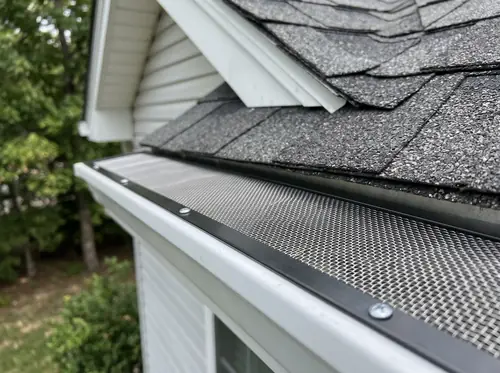
A guard covers the gutter so leaves and debris stay out while water gets in. A clean gutter drains, stays lighter, and is less likely to overflow onto the fascia or pull away from it under a load of soggy leaves. Around Lafayette, where many houses sit under live oaks, water oaks, pines and fast-growing tallow trees, that can mean the difference between cleaning several times a year and checking once or twice.
Which types of gutter guard are there?
| Type | How it works | Stops | Lets through | Page |
|---|---|---|---|---|
| Stainless micro-mesh | Fine mesh on a rigid frame | Leaves, catkins, pine straw, seed, most grit | Water; some fine pollen | Micro-mesh guards |
| Reverse-curve hood | Water follows a curved nose into a slot | Most leaves | Small debris can enter the slot | Screen and reverse-curve |
| Perforated metal screen | Sheet with holes over the trough | Whole leaves | Catkins, needles, seed, grit | Screen and reverse-curve |
| Plastic snap-in screen | Lightweight grid | Large leaves | Most small debris; warps in heat | |
| Foam or brush insert | Fills the trough | Some leaves | Holds debris; grows weeds |
Which guard suits which trees?
| What falls on the roof | Best guard | Why |
|---|---|---|
| Live oak leaves and catkins | Micro-mesh | Catkins are long and fine and slip through screens |
| Pine straw | Micro-mesh | Needles spear through screen holes and mat in the trough |
| Water oak and pecan leaves | Micro-mesh or reverse-curve | Larger leaves; both shed them well |
| Tallow tree seed and small debris | Micro-mesh | Seed and grit pass through coarse screens |
| Few trees, mostly grit and pollen | Basic screen or none | Cleaning may be easier than a guard |
How do guards handle heavy rain?
Lafayette's rain arrives in bursts. The August 2016 flood put two days of 10-plus inches on the city, and ordinary summer storms can drop an inch or more in under an hour. A guard has to let that water through as fast as the gutter can take it.
Micro-mesh panels with a good open area take water well, and the frame lifts the mesh so water spreads across it. Reverse-curve hoods depend on water following the curve; in a very heavy downpour on a steep roof, some overshoots. Whatever the guard, it only helps if the gutter beneath it has enough outlets and the downspouts drain freely. A clean guard over a 5-inch gutter with one outlet on a long run will still overflow in a big storm.
Which guard terms come up?
| Term | What it means on a Lafayette house |
|---|---|
| Micro-mesh guard | A fine stainless mesh on a frame over the gutter, which stops oak catkins, pine straw and grit while letting water pass. |
| Reverse-curve guard | A solid hood that lets water follow its rounded nose into the gutter while leaves slide off the front. |
| Screen guard | A perforated metal or plastic panel with large holes. It blocks whole leaves but lets catkins, needles and seeds through. |
| Foam insert | A porous block laid in the trough. It is cheap, but in a humid climate it holds debris and sprouts weeds within a few seasons. |
| Gutter apron | A broad flashing slipped under the first row of shingles and lapped into the gutter, used where shingles stop short of the trough. |
| Drip edge | Bent metal flashing along the roof edge that kicks water out past the fascia and into the trough instead of letting it creep back behind the gutter. |
| Hidden hanger | A bracket that hooks under the front lip and screws through the back of the gutter into the fascia, unseen from the yard. |
| Outlet | The opening in the gutter bottom where the downspout drops away, usually lined with a riveted sleeve. |
How are gutter guards fitted?
- Check the gutter. The contractor confirms the gutter is sound, sloped and firmly hung, and repairs or rehangs anything loose.
- Clean thoroughly. Troughs and downspouts are cleared and flushed, since anything left will sit under the guard.
- Cut to length. Panels are cut to each run and around corners, with miters trimmed to fit.
- Fasten. Most mesh guards screw to the front lip and tuck under or fix just below the drip edge, without lifting shingles.
- Seal and finish. Corners and ends are closed so debris cannot slip in, and valleys get extra attention.
- Water test. Water is run across the guards to check it reaches the outlets.
Are gutter guards worth the money?
That depends on the trees, the height of the house and how often the gutters clog now. Guards pay off fastest on two-story houses under heavy canopy, where each cleaning is a tall-ladder job. On a single-story house with one small tree, cleaning twice a year may cost less. The guards guide runs through the numbers and trade-offs.
| Situation | Guard worth considering? |
|---|---|
| Two-story house under live oaks or pines | Yes, usually micro-mesh |
| Gutters clog more than twice a year | Yes |
| Single-story, few trees | Maybe; compare with cleaning costs |
| Gutters already sagging or leaking | Fix those first |
| Steep metal roof | Ask about guards rated for fast runoff |
How do you look after a gutter guard?
- Look at the guards after spring catkin drop and after leaf fall in late fall.
- Brush or hose off any mat of pollen and catkins sitting on top of mesh.
- Check that downspouts run freely during a storm.
- After a hurricane or strong storm, look from the ground for panels that have lifted or shifted.