
On this page
- How do screen guards work?
- How do reverse-curve guards work?
- How do screen, hood and micro-mesh compare?
- Which terms come up with guards?
- When might a screen or hood make sense?
- How are they installed?
- What about foam and brush inserts?
- Screen and hood guards: quick answers
- Where does screen and hood guards come up around Acadiana?
- What is the one thing to do first?
How do screen guards work?
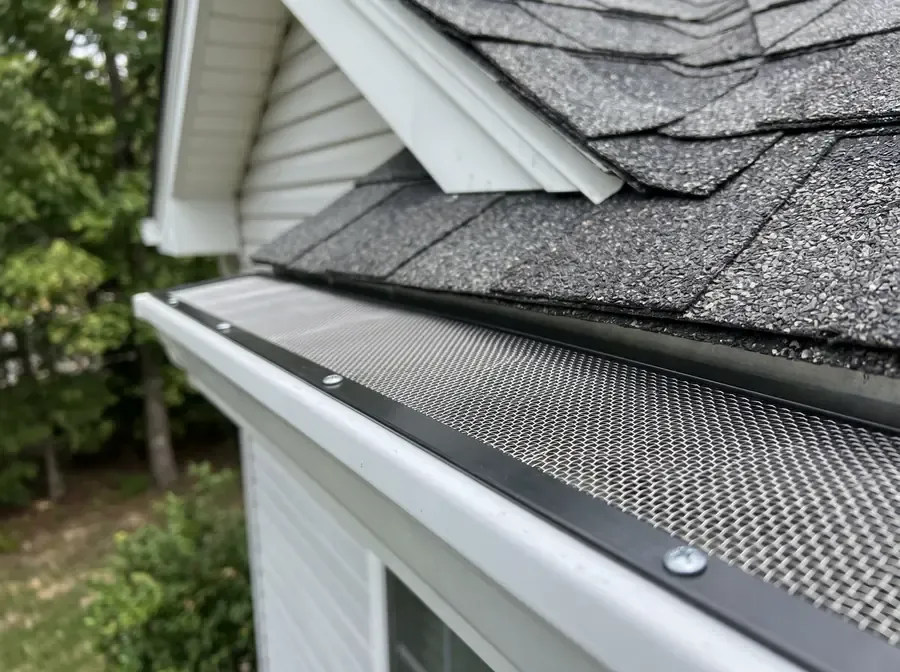
A screen guard is a perforated metal or plastic panel laid over the gutter. Water falls through the holes; whole leaves stay on top. Screens are inexpensive and easy to fit, and they make sense where debris is mostly large leaves.
The weakness is small debris. Live oak catkins, pine needles, tallow seed and grit pass through the holes or lodge in them. Under the live oaks that shade so much of Lafayette, that matters.
How do reverse-curve guards work?
A reverse-curve guard is a solid hood. Water flows down the roof, onto the hood, and follows the rounded nose into a narrow slot. Leaves keep going off the front. Hoods hide the gutter and shed big leaves very well.
Their weaknesses are capacity and small debris. In a very heavy burst, water can shoot past the nose, particularly on steep roofs. Fine debris that follows the water into the slot can build up inside, where it is harder to clean.
How do screen, hood and micro-mesh compare?
| Screen | Reverse-curve hood | Micro-mesh | |
|---|---|---|---|
| Stops whole leaves | Yes | Yes | Yes |
| Stops catkins and needles | Poorly | Partly | Yes |
| Heavy-rain capacity | Good | Can overshoot | Good if kept clean |
| Visibility | Visible from above | Hides the gutter | Low profile |
| Typical cost | Low | Higher | Moderate to higher |
| Upkeep | Clear holes, clean trough | Clean slot and trough occasionally | Rinse top occasionally |
Which terms come up with guards?
| Term | What it means on a Lafayette house |
|---|---|
| Screen guard | A perforated metal or plastic panel with large holes. It blocks whole leaves but lets catkins, needles and seeds through. |
| Reverse-curve guard | A solid hood that lets water follow its rounded nose into the gutter while leaves slide off the front. |
| Micro-mesh guard | A fine stainless mesh on a frame over the gutter, which stops oak catkins, pine straw and grit while letting water pass. |
| Foam insert | A porous block laid in the trough. It is cheap, but in a humid climate it holds debris and sprouts weeds within a few seasons. |
| Drip edge | Bent metal flashing along the roof edge that kicks water out past the fascia and into the trough instead of letting it creep back behind the gutter. |
| Outlet | The opening in the gutter bottom where the downspout drops away, usually lined with a riveted sleeve. |
| K-style gutter | The common flat-backed gutter with a molded front face. It carries more water than a half-round of the same nominal width. |
When might a screen or hood make sense?
| Situation | Screen | Hood |
|---|---|---|
| Mostly large leaves, few small trees | Good value | Works well |
| Live oaks or pines overhead | Poor | Fair |
| Steep roof, heavy rain | Fine | Risk of overshoot |
| Want the gutter hidden | Yes | |
| Tight budget | Yes |
How are they installed?
- Check and clean the gutters and downspouts.
- Fit screens into or onto the gutter, or hoods to the fascia and gutter lip.
- Trim corners and ends.
- Test with water, especially on steep roofs with hoods.
What about foam and brush inserts?
They are the cheapest option, but in Lafayette's humidity they hold debris and stay damp, and they can sprout weeds. Most contractors do not recommend them here.
Screen and hood guards: quick answers
| Question people ask | Short answer |
|---|---|
| Can screens be removed for cleaning? | Most snap or screw off |
| Do hoods suit half-round gutters? | Rarely; most hoods are made for K-style |
| Are hoods safe on steep roofs? | Water may overshoot in heavy rain; ask about testing |
| Do screens rust? | Aluminum and stainless screens do not; cheap steel ones can |
| Can screens and mesh be mixed? | Yes, mesh where trees overhang and screens elsewhere |
Where does screen and hood guards come up around Acadiana?
| Town or neighborhood | Why it matters there |
|---|---|
| Scott | Open lots with few trees where screens may do |
| Rayne | Single-story houses with mostly large leaves |
| Duson | Simple houses where cost matters most |
What is the one thing to do first?
Look up at what actually falls on your roof in spring. If it is catkins and needles, skip screens and price micro-mesh.