
On this page
- When are guards worth it?
- Why do Lafayette trees make guards attractive?
- Which guard types are there?
- How do the costs compare?
- Which terms come up?
- What are the downsides?
- How do guards fare in heavy rain?
- How should you decide?
- How do guard costs compare with cleaning over time?
- What makes a guard installation good or bad?
- Do guards help or hurt in hurricane season?
- Which houses benefit most around Lafayette?
- When should you skip guards?
When are guards worth it?
| Situation | Worth it? |
|---|---|
| Two-story house under live oaks or pines | Usually yes |
| Gutters clog more than twice a year | Usually yes |
| Steep roof, hard to reach | Usually yes |
| Single-story, few trees | Often not |
| Gutters sagging or leaking | Fix those first |
Why do Lafayette trees make guards attractive?
Lafayette is shaded by live oaks, with water oaks, pines, pecans and tallow trees mixed in. Live oaks drop leaves and catkins in a rush in spring; pines shed all year; other trees add leaves and seed in fall. That means several debris waves a year, and the small stuff, catkins and needles, packs into outlets. On a house under heavy canopy, cleaning only twice a year may not keep up.
Which guard types are there?
| Type | Stops catkins and needles | Heavy rain | Cost | Verdict here |
|---|---|---|---|---|
| Stainless micro-mesh | Yes | Good when clean | Moderate to higher | Best under oaks and pines |
| Reverse-curve hood | Partly | Can overshoot on steep roofs | Higher | Good for big leaves |
| Metal screen | No | Good | Low | Only for large leaves |
| Plastic screen | No | Good | Low | Warps in heat |
| Foam or brush insert | No | Fair | Lowest | Holds debris in humidity |
How do the costs compare?
Compare the guard's installed price with what you spend on cleanings. If a two-story house needs three or four paid cleanings a year, guards can pay for themselves within a few years. If you clean a single-story house yourself twice a year, they may never pay off in money, though they still save time and ladder work.
Which terms come up?
| Term | What it means on a Lafayette house |
|---|---|
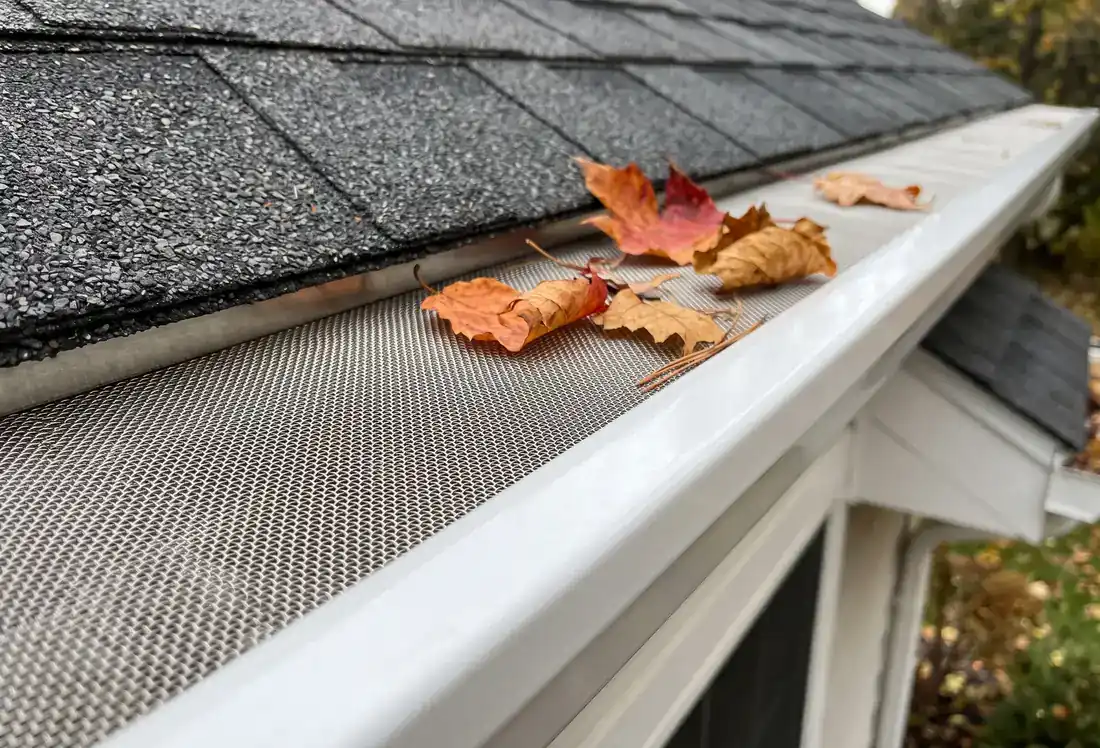
| Micro-mesh guard | A fine stainless mesh on a frame over the gutter, which stops oak catkins, pine straw and grit while letting water pass. |
| Reverse-curve guard | A solid hood that lets water follow its rounded nose into the gutter while leaves slide off the front. |
| Screen guard | A perforated metal or plastic panel with large holes. It blocks whole leaves but lets catkins, needles and seeds through. |
| Foam insert | A porous block laid in the trough. It is cheap, but in a humid climate it holds debris and sprouts weeds within a few seasons. |
| Drip edge | Bent metal flashing along the roof edge that kicks water out past the fascia and into the trough instead of letting it creep back behind the gutter. |
| Outlet | The opening in the gutter bottom where the downspout drops away, usually lined with a riveted sleeve. |
What are the downsides?
- Up-front cost.
- Some maintenance remains: rinsing mesh, checking downspouts.
- Poorly fitted guards can lift shingles or shed water in heavy rain.
- Guards do not fix sagging, leaking or undersized gutters.
How do guards fare in heavy rain?
With 62.81 inches a year and frequent cloudbursts, guards must pass water fast. Clean micro-mesh does this well; hoods can overshoot in the heaviest bursts on steep roofs. Whatever the guard, the gutter underneath needs enough outlets.
How should you decide?
- Count how often your gutters clog now.
- Price cleanings for a few years.
- Get a quote for micro-mesh on sound gutters.
- Factor in house height and your own safety.
How do guard costs compare with cleaning over time?
This example uses round numbers to show how the comparison works. Ask contractors for real prices on your house.
| Scenario | Cleanings a year | Over 10 years |
|---|---|---|
| Single-story, few trees, DIY | 1 to 2, your own time | Mostly your time |
| Single-story under oaks, paid | 2 to 3 | 20 to 30 paid cleanings |
| Two-story under oaks and pines, paid | 3 to 4 | 30 to 40 paid cleanings |
| Any house with good micro-mesh | Occasional rinse | A few light cleanings |
On a two-story house under heavy canopy, 30 or more paid cleanings over a decade often cost more than good guards. On a single-story house with few trees, they may not.
What makes a guard installation good or bad?
| Good sign | Warning sign |
|---|---|
| Stainless mesh on a rigid metal frame | Plastic frame or flimsy mesh |
| Fixed to the gutter lip and fascia without lifting shingles | Panels shoved under shingles |
| Corners and ends closed | Gaps where debris can enter |
| Gutters repaired and rehung first | Guards fitted over sagging runs |
| Water test after fitting | No testing |
Do guards help or hurt in hurricane season?
They help by keeping gutters clear when tropical rain arrives. A gutter packed with leaves going into a storm will overflow; a guarded gutter is more likely to drain. They do not add strength, so hangers and fascia still matter. After a storm, check from the ground that no panels have lifted.
Which houses benefit most around Lafayette?
- Older houses under big live oaks in Sterling Grove, Breaux Bridge and St. Martinville.
- Two-story houses in Youngsville and Broussard where cleaning needs tall ladders.
- Houses near pines, where needles spear through screens.
When should you skip guards?
If your gutters rarely clog, the house is single-story and you clean them yourself safely, guards may not pay off. Spend the money on enough outlets and good drainage instead.