
On this page
- How do seamless and sectional gutters differ?
- Why do joints matter in Lafayette?
- Which terms come up?
- When does sectional still make sense?
- What do they cost?
- How do you tell what you have now?
- Should you replace sectional gutters?
- Which parts are joined in each system?
- How do sectional joints fail?
- How do you judge a seamless installation?
- Is sectional ever the better long-term choice?
- What should a seamless quote include?
How do seamless and sectional gutters differ?
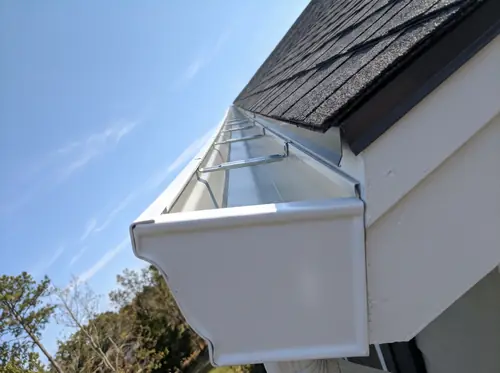
Seamless gutters are rolled from coil on a machine at the house, one piece per wall. Sectional gutters come in 10 or 20-foot lengths, joined with slip connectors and sealant.
| Seamless | Sectional | |
|---|---|---|
| Joints along a 40-foot wall | None | Three or more |
| Leak points | Corners, ends, outlets | Every joint, plus corners, ends, outlets |
| Fit | Exact to each wall | Cut from stock lengths |
| Look | Continuous line | Visible seams |
| Installed by | Contractor with a machine | Contractor or DIY |
| Common metals | Aluminum, steel, some copper | Vinyl, aluminum, steel, copper |
Why do joints matter in Lafayette?
Every joint is held by sealant and rivets, and sealant ages. Lafayette's long, hot summers bake it, aluminum expands and contracts daily, and with 62.81 inches of rain a year the joints are wet often. A slip joint that would last many years in a dry climate can start dripping sooner here.
Which terms come up?
| Term | What it means on a Lafayette house |
|---|---|
| Seamless gutter | Gutter rolled out of a coil of painted metal on a machine at the house, one piece per wall, so joints only occur at corners and ends. |
| Sectional gutter | Gutter bought in 10 or 20-foot lengths and joined with connectors. Each connector is a seam that can open up in Gulf Coast heat. |
| Miter | The joint at a corner, cut, riveted and sealed. Corners carry the most water and are where most leaks start. |
| End cap | The closure crimped and sealed onto each end of a run. |
| Outlet | The opening in the gutter bottom where the downspout drops away, usually lined with a riveted sleeve. |
| Coil stock | The roll of factory-painted aluminum, steel or copper fed through the gutter machine. |
| Hidden hanger | A bracket that hooks under the front lip and screws through the back of the gutter into the fascia, unseen from the yard. |
When does sectional still make sense?
| Situation | Why sectional may suit |
|---|---|
| Copper half-round on a historic house | Sections with soldered joints are traditional and durable |
| Small DIY repair | Matching a short sectional run |
| Very short runs | Joints are few anyway |
| Profiles not available seamless locally | Sections may be the only option |
What do they cost?
Seamless aluminum runs about $9 to $13 a foot installed nationally for 5-inch, per Angi. Sectional material bought for DIY is often cheaper, but installed by a contractor the gap narrows, and the long-term cost of leaks and fascia repair favors seamless on most houses.
How do you tell what you have now?
Look along the gutter from the ground. If you see joints every 10 feet or so, with connectors and sealant, it is sectional. If the run is continuous from corner to corner, it is seamless.
Should you replace sectional gutters?
If they leak at several joints, sag or are fixed with spikes, replacing with seamless is usually the better investment. The repair or replace guide helps decide.
Which parts are joined in each system?
| Joint | Seamless | Sectional |
|---|---|---|
| Along the run | None | Every 10 or 20 feet |
| Inside corners | Yes | Yes |
| Outside corners | Yes | Yes |
| End caps | Yes | Yes |
| Outlets | Yes | Yes |
| Total joints on a typical 150-foot house | Perhaps 15 to 20 | Perhaps 30 or more |
The figures in the last row are illustrative for a simple house; the point is that sectional systems add a joint every length, on top of the joints every gutter has.
How do sectional joints fail?
A slip joint overlaps two lengths and relies on sealant to keep water in. As aluminum heats and cools each day it expands and contracts, and that movement works the sealant. Over time it cracks or pulls away. Water then drips at the joint, often onto the same patch of fascia, siding or ground, for every storm until it is fixed. In a climate with rain on more than 115 days a year at Lafayette Regional Airport, that adds up.
How do you judge a seamless installation?
- Corners: look for neat, riveted miters with sealant inside the trough, not smeared outside.
- End caps: crimped tight and sealed, with no gaps.
- Hangers: hidden hangers about every 2 feet; no spikes.
- Slope: a steady fall toward each outlet, without dips.
- Outlets: clean cuts with a sleeve riveted in.
- Water test: the contractor should run water to show it drains.
Is sectional ever the better long-term choice?
Sectional copper half-round with soldered joints is a respected traditional system that lasts a very long time, because solder does not age like sealant. On historic houses in Sterling Grove or St. Martinville, that may be the right call. For painted aluminum K-style on a typical house, seamless is the usual choice.
What should a seamless quote include?
| Item | What to look for |
|---|---|
| Profile and size | 5 or 6-inch K-style, or half-round |
| Metal and thickness | .027 or .032 aluminum, steel, copper |
| Hangers | Type and spacing |
| Corners | Miter style and how they are sealed |
| Downspouts | Number, size and discharge |
| Removal | Old gutters taken away |