
On this page
- What is a good cleaning schedule?
- Why does Lafayette need more frequent cleaning than many places?
- What are the signs gutters are overdue?
- Which terms come up?
- What does a full cleaning include?
- How do trees change the schedule?
- Should you do it yourself?
- What does each kind of tree drop, and when?
- How does cleaning change on different houses?
- What is a do-it-yourself cleaning checklist?
- Does weather change the schedule?
What is a good cleaning schedule?
| Timing | Why |
|---|---|
| Late April to May | After live oak catkins and spring leaf drop; before the wettest months and hurricane season |
| Late November to December | After water oak, pecan and tallow leaves are down |
| After major storms | Clear wind-blown debris and check for damage |
| Extra cleanings | Under heavy pine or oak cover, every three to four months |
Why does Lafayette need more frequent cleaning than many places?
Evergreen oaks. Live oaks hold their leaves through winter and drop them in spring along with catkins, a different rhythm from deciduous trees.
Pines. Needles fall year round and mat in the trough.
Rain. At 62.81 inches a year, with June, July and August the wettest months, a half-full gutter overflows often.
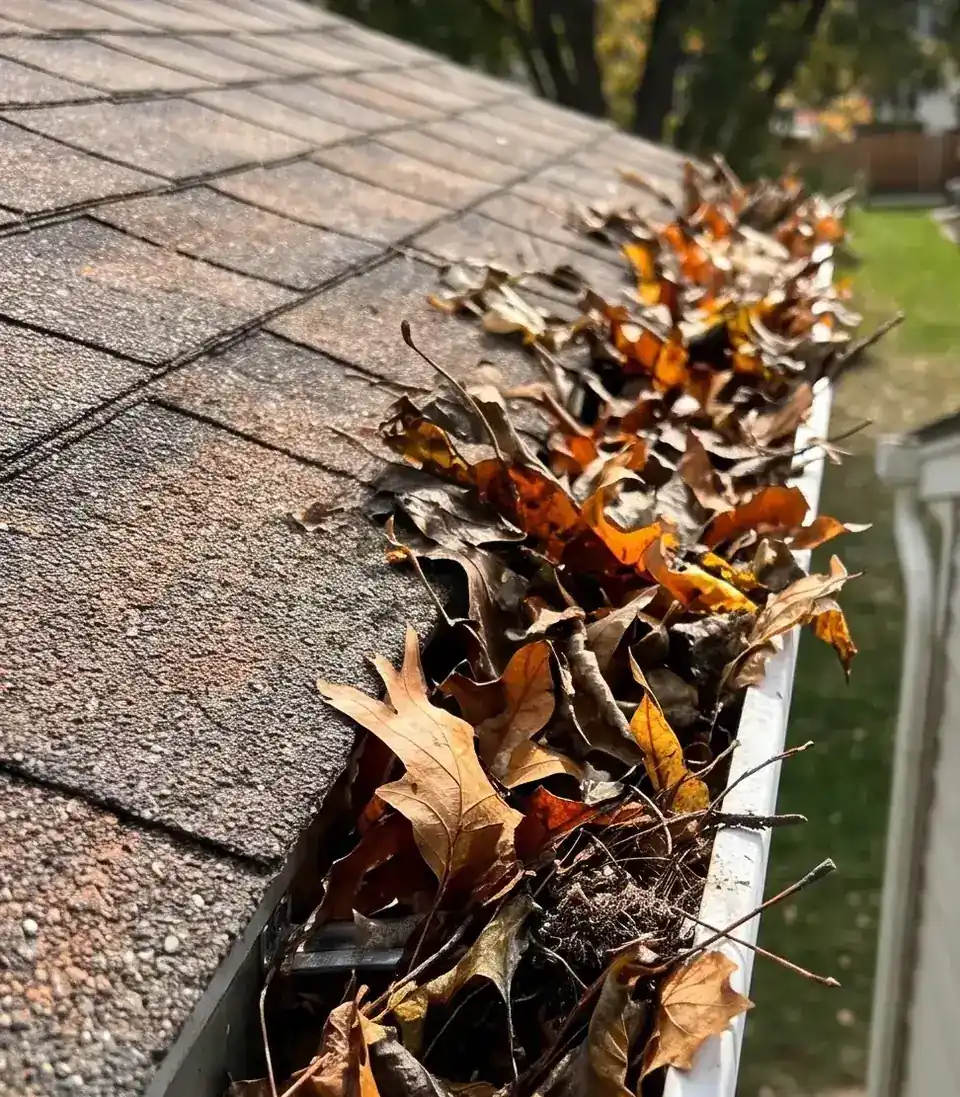
Humidity. Wet debris in a warm, damp gutter breaks down into sludge and can sprout seedlings.
What are the signs gutters are overdue?
- Water pours over the front in normal rain.
- Seedlings or grass grow in the trough.
- Downspouts do not run during rain.
- Gutters sag where debris collects.
- Stains appear on fascia or siding below the gutter.
- Mosquitoes breed in standing water in the gutter.
Which terms come up?
| Term | What it means on a Lafayette house |
|---|---|
| Outlet | The opening in the gutter bottom where the downspout drops away, usually lined with a riveted sleeve. |
| A elbow | A downspout elbow that turns front to back, used to bring the pipe in from the overhang to the wall. |
| Downspout | The pipe that carries water from the gutter to the ground. 2x3 and 3x4 inch are standard; a 3x4 carries roughly twice as much. |
| Slope | The fall of a gutter toward its outlet, often around a quarter inch per 10 feet, enough to keep water moving without looking crooked. |
| Micro-mesh guard | A fine stainless mesh on a frame over the gutter, which stops oak catkins, pine straw and grit while letting water pass. |
| Screen guard | A perforated metal or plastic panel with large holes. It blocks whole leaves but lets catkins, needles and seeds through. |
What does a full cleaning include?
- Debris scooped from every run.
- Outlets cleared.
- Downspouts flushed and elbows cleared.
- Hangers, corners and fascia checked.
- Extensions and splash blocks put back.
How do trees change the schedule?
| Trees near the house | Cleanings a year |
|---|---|
| None or few | 1 to 2 |
| A couple of deciduous trees | 2 |
| Live oaks | 2 to 3 |
| Pines | 3 to 4 |
| Mixed heavy canopy | 3 to 4, or guards |
Should you do it yourself?
On a single-story house, with a stable ladder on firm ground and dry weather, many people do. Two-story houses, steep roofs and wet or windy days are where accidents happen. The gutter cleaning page covers safety and what a professional cleaning includes.
What does each kind of tree drop, and when?
| Tree | What falls | Peak timing | What it does in a gutter |
|---|---|---|---|
| Live oak | Small leaves, long catkins, acorns | Late winter to spring | Catkins mat into a dense layer that blocks outlets |
| Water oak | Leaves | Late fall into winter | Leaves pile at corners and outlets |
| Pine | Needles, cones | All year, heavier in fall | Needles spear through screens and knit into mats |
| Pecan | Leaves, husks, twigs | Fall | Husks and twigs jam elbows |
| Chinese tallow | Leaves, waxy seed | Fall and winter | Seed slips into outlets |
| Crape myrtle | Flowers, seed pods | Summer and fall | Small debris that clogs fine openings |
Lafayette's live oaks set the rhythm. Because they are evergreen, they shed old leaves in a rush when new growth starts, along with catkins and pollen. A gutter cleaned in early March can be full again by late April. That is why the most important cleaning here is late spring, not fall.
How does cleaning change on different houses?
| House | Approach |
|---|---|
| Single-story ranch, few trees | One or two cleanings; many owners do it themselves |
| Single-story under oaks | Two or three cleanings, or guards |
| Two-story under any trees | Professional cleaning or guards; tall ladders are risky |
| Raised house | Check downspouts carry water past the piers after each cleaning |
| Metal roof | Debris slides quickly into gutters; clean more often |
| House with guards | Rinse guards and check downspouts once or twice a year |
What is a do-it-yourself cleaning checklist?
- Pick a dry, calm day; never clean during or right after rain.
- Set a sturdy ladder on firm, level ground with a stabilizer arm.
- Start at a downspout and work away from it, scooping debris into a bucket.
- Flush each run with a hose toward the outlet.
- Flush each downspout; if water backs up, clear the bottom elbow.
- Look at hangers, corners and fascia while you are there.
- Put extensions and splash blocks back in place.
If any part of that is uncomfortable, call a professional. Falls from ladders are a common household injury, and gutters are rarely worth the risk on two-story houses.
Does weather change the schedule?
Yes. After a named storm or a strong squall line, check gutters even if they were recently cleaned; wind strips leaves and twigs from trees. Before a forecast tropical system, a quick check of outlets and downspouts is worthwhile. And with the wettest months averaging over 6 inches each in the NOAA normals, clean gutters going into June matter most.